
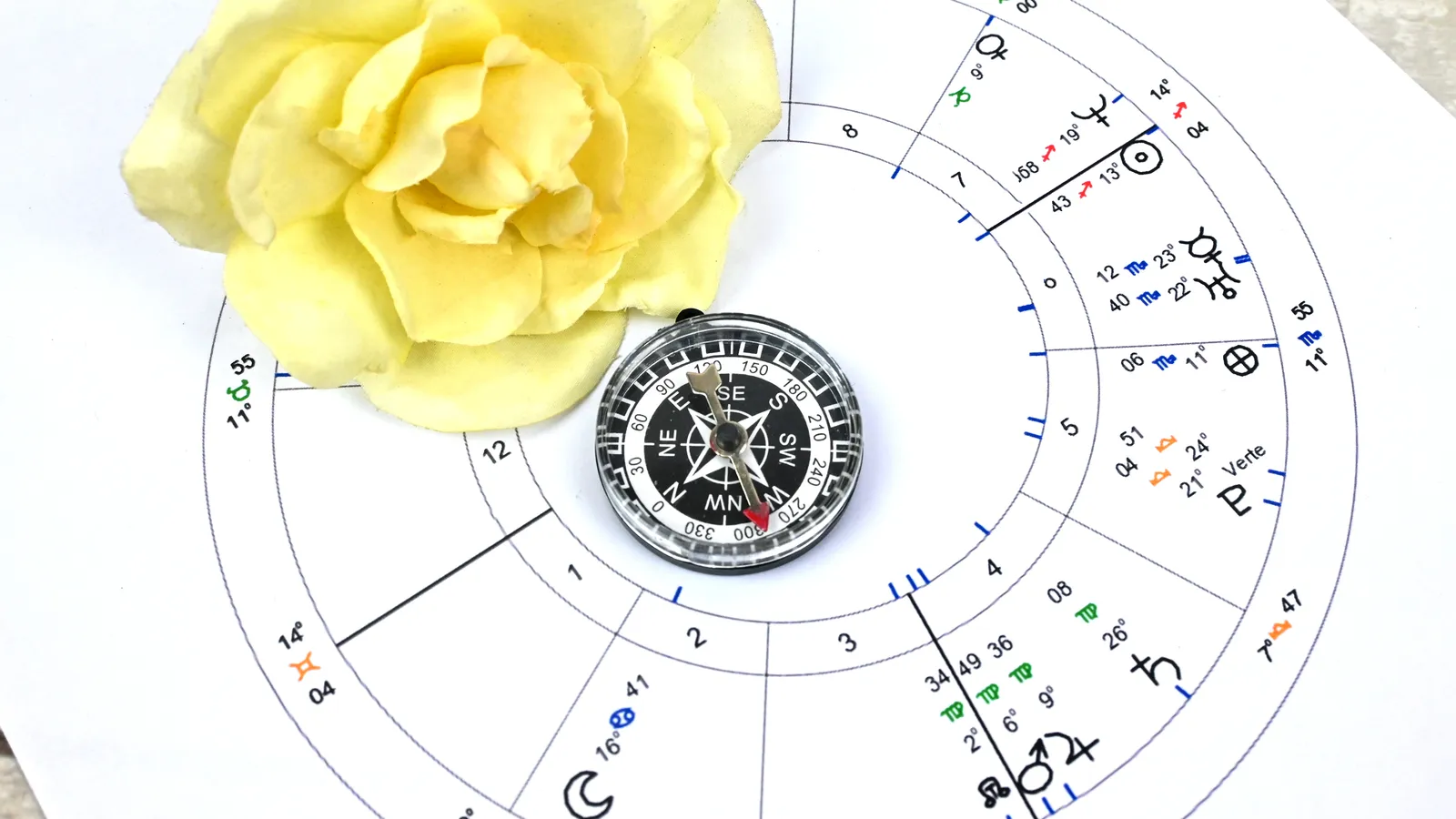
A natal chart reading maps the exact positions of the sun, moon, and planets at your birth moment, then interprets what those placements mean for your patterns. It differs from a daily horoscope because it is built from your specific birth date, time, and location rather than sun sign alone. A good reading names the shadow a pattern protects, not just the behavior itself.
What Does a Natal Chart Reading Actually Tell You?
A chart reading describes the psychological architecture you were born into. It covers ten planets, twelve houses, and the angles between them, each one a layer of how you process love, fear, ambition, and grief.
Think of the chart less as a prediction and more as a weather map of your inner climate. The sun shows your core identity. The moon reveals emotional needs, often shaped in childhood. Mercury shapes how you think and speak, Venus shows what you value and how you love, Mars shows how you assert yourself or avoid conflict.
Houses matter as much as planets. A chart reading that ignores house placement misses half the story, because the same planet behaves differently in the 4th house of home than in the 10th house of career. This is why two people with the same sun sign can live entirely different lives.
Is a Birth Chart Reading Free Worth Doing First?
Free tools can calculate your chart accurately if you know your exact birth time. They fall short at interpretation, especially around repeating patterns that need a human reading context, not just a definition list.
A free chart generator will produce your placements correctly using the same ephemeris data professionals use. The NASA JPL database confirms planetary positions to the degree, so the raw data is not in dispute. What a free generator cannot do is notice that your Saturn in the 7th house keeps showing up in the same relationship pattern you described three different ways.
Free charts are a reasonable starting point if you are curious about your placements. They become limiting once you want to understand why a pattern keeps recurring, not just that it exists. For a deeper look at how to read your own symbols before paying for anything, the natal chart explained guide walks through the basics in plain language.
How Does a Reading Explain Repeating Patterns?
Repeating patterns in a chart usually trace back to hard aspects, meaning tense angles between planets such as squares or oppositions. A square is a 90 degree angle that creates friction and often shows where growth has been slow or resisted.
The pattern is not random. It is a protective structure built early, often in childhood, that once kept something safe and now may keep something stuck. A person with Moon square Saturn might have learned young that needing comfort led to disappointment, so now they minimize their own needs as adults. The chart does not just name the wound, it shows the logic behind the defense.
Saturn transits are a clear example. Saturn square natal Saturn tends to arrive around ages 7, 14, 21, 36, 43, and 50, each time asking what structure in your life needs rebuilding. When Saturn squares your natal Saturn, which happens around age 29 as the Saturn return approaches, old protective patterns often surface for review, not punishment.
This is the same lens used in work on the mother wound in astrology, where early relational patterns imprint onto the 4th house and the moon, then repeat in adult attachments until they are named directly.
What Should You Expect From a Professional Reading?
A professional reading should connect specific placements to specific patterns in your life, not offer generic trait lists. It should also leave room for complexity rather than reducing you to a single sign or aspect.
Expect a reading to walk through your sun, moon, rising sign, and a handful of key aspects relevant to what you are asking about, whether that is relationships, career, or recurring emotional loops. A reading focused on partnership patterns might spend more time on Venus, Mars, and the 7th house. One focused on career direction will lean on the 10th house and any placements there.
A written reading, delivered by email, allows you to sit with the material rather than absorb it all at once in conversation. This format works well for pattern work specifically, because recognizing a repeating behavior often takes rereading, not just hearing it once.
| Question | Chart area examined | What it tends to reveal |
|---|---|---|
| Why do I repeat the same relationship pattern? | Venus, Mars, 7th house | Attraction patterns and unmet needs in partnership |
| Why does my career feel stuck? | 10th house, Saturn, Midheaven | Public role, ambition, and self-imposed limits |
| Why do I feel anxious about money? | 2nd house, Venus, Jupiter | Core sense of worth and security |
| Why do I avoid my own needs? | Moon, 4th house, Chiron | Early emotional conditioning and self-protection |
When Is the Right Time to Get a Reading?
There is no required timing for a first chart reading, since your birth chart does not change. Certain astrological windows do make the timing more relevant to current life questions.
Saturn returns, occurring between ages 27 and 30 and again between 57 and 60, are common reasons people seek a reading, since this period often forces a reckoning with structures built earlier in life. Jupiter returns, happening roughly every 11.9 years, mark cycles of growth and opportunity worth examining. The Uranus opposition around age 42 often brings a desire to understand oneself differently than before.
As of October 8, 2026, the planetary movements through early 2027 show Venus shifting through six signs between January and April alone, moving from Sagittarius into Capricorn, Aquarius, Pisces, Aries, and Taurus. Mars moves more slowly, entering Leo on February 22, 2027, then Virgo on May 15, 2027. These shifts affect short term mood and relational tone more than core identity, but they can be useful markers if you want to time a reading around a specific transit. You can verify any planetary position yourself through Astro.com, which maintains detailed ephemeris tables.
If you are in a period of visible change, such as a Saturn return or Uranus opposition, a reading can help you see the pattern underneath the upheaval rather than just the upheaval itself.
How Do You Prepare for a Birth Chart Session?
Preparation mostly means having accurate birth data: date, time, and location. Without an exact birth time, house placements and rising sign cannot be calculated correctly, which limits how specific a reading can be.
If you do not know your exact birth time, a birth certificate or hospital record usually has it. Some people use a “noon chart” as an approximation, but this removes house placements and the rising sign from consideration entirely. It is worth the effort to find the real time if you want a reading that addresses specific patterns rather than broad sun sign traits.
Beyond birth data, it helps to know what you actually want to understand. A reading focused on “tell me about myself” tends to stay general. A reading focused on “why do I keep ending relationships the same way” or “why does structure feel so hard to maintain” gives the astrologer something concrete to trace through the chart.
Readers working through repeated relational patterns sometimes benefit from pairing a chart reading with other self-reflection tools, such as the attachment style quiz, which examines early bonding patterns from a psychological angle rather than an astrological one. The two lenses often confirm each other. If your natal chart free guide search already gave you your placements, bring those details into any reading you request.
What Does a Reading Not Do?
A chart reading does not predict fixed outcomes, diagnose mental health conditions, or replace professional medical or financial guidance. It is a framework for reflection, not a determinist map of your future.
No reading can tell you with certainty what will happen in a relationship, a job, or a health matter. What it can do is describe tendencies, timing patterns, and psychological structures worth paying attention to. Think of it as a compass, not a GPS. It shows direction and terrain, not guaranteed arrival.
This distinction matters because the value of chart work lives in the questions it raises. As Iris Vane often notes in her approach to shadow and pattern work, the chart is most useful when it asks what a behavior is protecting, before it asks how to change that behavior. Change follows understanding, not the other way around.
For a broader orientation to how all of this fits together, the patterns hub collects related readings on inner child work, attachment, and recurring family dynamics, each approaching the same core question from a different angle.
If you want this kind of layered reading applied to your own birth chart, Iris’s readings by email walk through your placements and the patterns they tend to protect.