 ## How does the shadow show up in a birth chart?
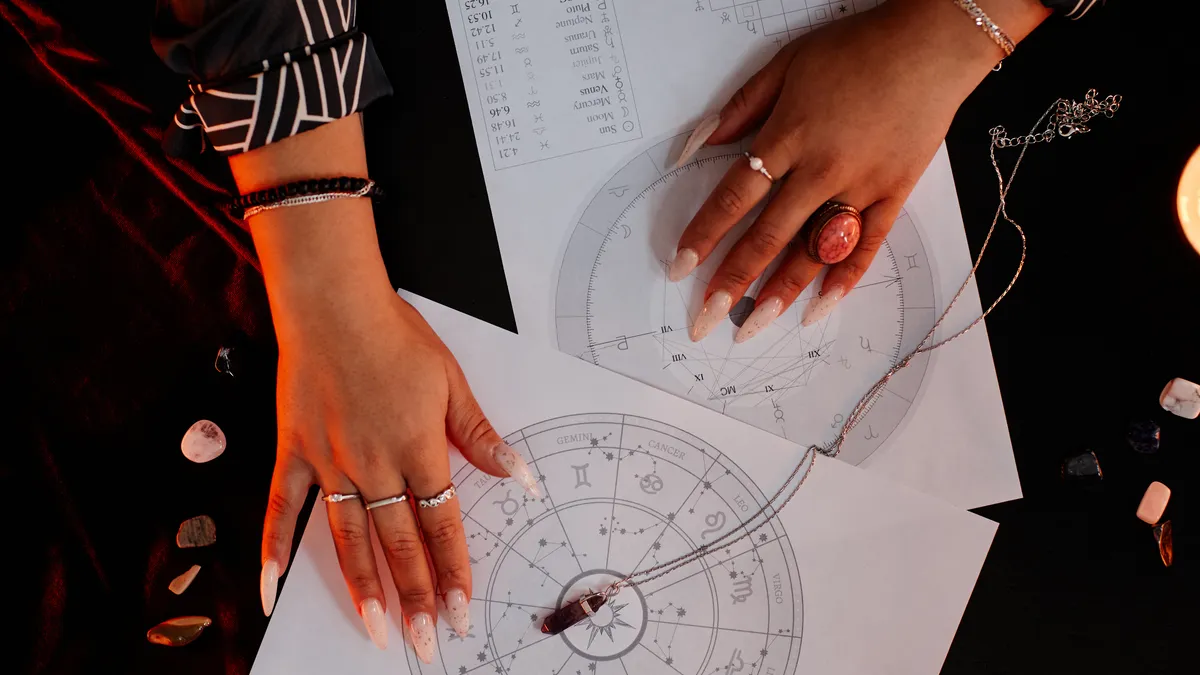
A birth chart is a map of where the planets were at the exact moment and place you were born. Astrology does not prove where your shadow lives, but certain placements offer a useful language for it. I read them as invitations to look, never as verdicts.
If you are new to chart reading, start with [what your birth chart says about you](/patterns/what-your-birth-chart-says-about-you). The placements below are the ones I return to most when someone asks why a pattern keeps coming back.
### Saturn: the rules you learned to follow
Saturn is the planet of structure, limits, and fear. Its sign and house often point to where you learned to be careful, controlled, or ashamed. A house is one of twelve sections of the chart, each tied to an area of life.
Saturn in the 7th house, the house of partnership, might show someone who learned that closeness requires performance. Saturn in the 2nd house, the house of money and worth, can describe a person who keeps proving their value through effort. Saturn in the 4th house, the house of home and family, often points to early rules about whose feelings counted.
### Pluto: power and what you refuse to feel
Pluto is the slow outer planet linked to power, control, and deep transformation. People often deny their own power where Pluto sits, then meet it in others who seem to control them. The guide to [Pluto in your birth chart and its themes of control](/patterns/pluto-in-birth-chart) explores this in depth.
### Chiron: the wound that teaches
Chiron is a small body astrologers read as the core wound, the place that hurts and also learns to help others heal. Shadow material often clusters around it, since we hide what once hurt most. You can read more on [Chiron and your core wound](/patterns/chiron-in-birth-chart).
### Lilith and the hidden houses
Black Moon Lilith is a calculated point in the chart linked to raw instinct, rage, and desire that was punished. The article on [where you hide your raw instinct with Lilith](/patterns/lilith-in-birth-chart) shows how this point often marks the first thing a person learned to suppress.
The 8th house covers shared resources, intimacy, and what we merge with others. The 12th house holds what stays hidden even from ourselves. Planets in either house often carry shadow themes that surface slowly, usually through relationships and solitude.
## When do shadow patterns tend to surface?
Shadow material tends to rise when life pressure exposes an old strategy that no longer works. In astrology, that pressure is often linked to transits, which are the current movements of planets measured against your birth chart. Saturn's cycle is the clearest example.
Saturn returns to its natal position about every 29.5 years. Natal simply means belonging to your birth chart. The first Saturn return lands between ages 27 and 30, and the second between 57 and 60.
Along the way, Saturn forms squares and oppositions to its own natal place. A square is a 90 degree angle, read as friction that pushes you to act. An opposition is a 180 degree angle, read as tension between two sides of your life.
When Saturn squares your natal Saturn, which happens around ages 21 to 22, the rules you built to stay safe can start to feel like walls. The square around 36 to 37 often asks whether your life reflects you or the approval you were chasing. In my reading, these are the ages when the shadow knocks loudest.
| Approximate age | Saturn transit | Shadow question it may raise |
|---|---|---|
| 7 | Saturn squares natal Saturn | Which feelings did I learn to hide to be accepted? |
| 14 to 15 | Saturn opposes natal Saturn | Who am I when I push against the rules? |
| 21 to 22 | Saturn squares natal Saturn | Which childhood rules am I still obeying? |
| 27 to 30 | First Saturn return | Is this life mine, or one I was handed? |
| 36 to 37 | Saturn squares natal Saturn | What did I trade away for approval? |
| 44 to 45 | Saturn opposes natal Saturn | Which disowned part is asking to come home? |
| 51 to 52 | Saturn squares natal Saturn | What fear still decides for me? |
| 57 to 60 | Second Saturn return | What do I want to stop carrying? |
| Date | Ingress | Shadow theme that may surface |
|---|---|---|
| February 21, 2027 | Mars enters Leo | Shame about wanting attention or credit |
| July 26, 2027 | Jupiter enters Virgo | A louder inner critic and perfectionism |
| September 1, 2027 | Mars enters Scorpio | Anger, jealousy, and the urge to control |
| October 7, 2027 | Venus enters Scorpio | Possessive desire and fear of betrayal |
| November 25, 2027 | Mars and Venus both enter Capricorn | Coldness used as armor against need |
 ## How do you do shadow work, step by step?
Learning how to do shadow work starts with slowing down, not digging up. The method below moves from noticing to integrating, and each step can take days or weeks. There is no prize for speed.
### Step 1: Catch the trigger
Start by noticing moments when your reaction feels too big. Maybe a coworker's confidence makes you seethe, or a friend's neediness makes you go cold. Write down what happened in plain facts, before any interpretation.
### Step 2: Name the feeling, then the part
Next, name the feeling in one or two words: envy, shame, rage, fear. Then give the part of you that feels it a simple name, like "the one who has to be good." Naming creates a little distance, and distance makes curiosity possible.
### Step 3: Ask what it protects
This is the center of the work. Ask the part, gently, what it is afraid would happen if it stopped. The answer is often surprising: "If I stop pleasing people, I will be alone."
Do not argue with the answer yet. A protective pattern relaxes when it feels understood, not when it feels attacked. Thank it, even if that feels strange.
### Step 4: Trace where it began
Ask when you first needed this protection. Often a memory, a family rule, or a single phrase comes up. You are not hunting for someone to blame, only for the moment the strategy made sense.
If you work with astrology, this is a good step to check your chart. Saturn, Chiron, and the Moon often echo the early story. The chart can confirm a theme you already sense in your body.
### Step 5: Offer the part a new job
Protective parts rarely want to disappear. They want to be useful. The people-pleaser might become the part that reads a room well, without abandoning you to do it.
### Step 6: Practice one small, different choice
Integration happens in behavior, not insight alone. Choose one small action that lets the hidden trait breathe. Say no to one request, or let yourself rest for twenty minutes without earning it.
Expect the old fear to flare. That flare is the pattern checking whether you are still safe. Each time you stay steady, the nervous system gathers a little new evidence.
## What should you write in a shadow journal?
A shadow work journal is a private place to record triggers, dreams, and answers to prompts without editing yourself. Handwriting tends to slow the mind, but any format works if you write without censoring. Keep it somewhere no one else will read it.
A simple daily entry might follow this structure:
- **What happened:** the facts, in two or three lines.
- **What I felt:** the emotion and where it sat in my body.
- **What I told myself:** the thought that came fast.
- **The old story:** when I first felt this way.
- **What it protects:** the fear underneath.
- **One small choice:** what I will try next time.
Dreams belong here too. Shadow figures often appear as strangers, intruders, or people of your own gender you dislike. Note how you felt toward them, since that feeling often matches what you reject in yourself.
Review your entries once a month. Patterns that felt random usually start to cluster around the same few fears. Those clusters are your real map, and they often match the placements discussed above.
## What prompts help you meet the shadow?
Good shadow work prompts are specific and kind. They point toward the hidden part without shaming it. Pick one or two per entry rather than racing through a list.
### Prompts for projection
- Who irritates me most right now, and what quality in them bothers me?
- Where might that quality live in me, even in a small form?
- Whom do I admire so much it stings, and what do they allow themselves?
### Prompts for origin
- What was I praised for as a child, and what was I punished for?
- Which emotion was not allowed in my family?
- What did I decide about myself the first time I felt rejected?
### Prompts for protection
- If this pattern stopped tomorrow, what am I afraid would happen?
- What has this pattern helped me avoid feeling?
- What would this part need to feel safe enough to rest?
### Prompts for the golden shadow
- What talent do I downplay so others will not feel threatened?
- What do I secretly want people to notice about me?
- What would I do if I were not afraid of being too much?
### Prompts from your chart
- Where is my Saturn, and what rule have I followed in that area of life?
- What does my Chiron placement say about the hurt I hide best?
- Which planet in my 8th or 12th house feels least like me?
If relationship fears keep surfacing in your answers, the pieces on [anxious attachment and its roots](/patterns/anxious-attachment-signs-roots) and on [why avoidant people pull away](/patterns/avoidant-attachment-why-you-pull-away) can add another lens.
## Should you do this inner work alone, and when is it too much?
Many people do shadow work on their own with a journal, and that can be meaningful. Some material is too heavy to hold alone, though. Knowing the signs of overload is part of doing this well.
Pause if journaling leaves you flooded for hours, if old memories intrude on sleep, or if you start using insights to attack yourself. These are signs to slow down and find support. A licensed therapist, especially one trained in trauma, can offer a steadier container than a notebook.
Watch for spiritual bypass too. Spiritual bypass means using insight or positive language to skip over real pain. Saying "I have done my shadow work" while still exploding at loved ones is a sign the work stayed in the head.
The same caution applies to astrology. A chart can describe a theme, but it never excuses harm or seals your fate. Saturn in a hard place is a reason for compassion and effort, not a life sentence.
Rest is part of the method. Integration often happens in quiet weeks between insights, when the nervous system catches up. If you are moving through a Saturn square or return, give yourself more room, not less.
## What changes when the shadow is met?
Meeting the shadow rarely feels like a single breakthrough. It feels more like reactions losing their charge, one situation at a time. You notice the old heat, and you have a half second to choose.
People often find that the traits they feared most carry real gifts. Anger becomes clear boundaries. Need becomes the capacity for closeness. Ambition becomes direction instead of a desperate proof of worth.
The pattern does not have to vanish for life to change. It only has to stop working in the dark. That is why I always begin with what a pattern protects, and you can read more about [how I read charts through shadow and repetition](/about/iris-vane).
For more guides on the loops people find themselves in, browse [the full library of pattern guides](/patterns) or return to [the Why Do I Keep Doing This home page](/)