# South Node Meaning: What Feels Familiar in Your Chart

The south node marks the skills, reflexes and roles that feel familiar in your birth chart. See what it protects and when the pattern starts to limit you.

By Iris Vane · 2026-11-13 · https://whydoikeepdoingthis.com/patterns/south-node-meaning-birth-chart

## What does the south node mean?

The south node is the point in your birth chart where the Moon's orbit crossed the Sun's path, heading south, when you were born. The south node meaning centers on what already feels familiar: the skills, reflexes and roles you fall into without trying. It is not a punishment. It is a pattern you know by heart, and it usually protects something long before it starts to limit you.

As of November 13, 2026, this guide covers how to find this point in your chart and what each sign and house placement tends to look like. It also shows which upcoming planetary movements may stir the pattern. Along the way it answers the technical questions people type late at night, such as whether the true node is the descending node and whether this placement is Ketu.

The descending lunar node is one half of a pair of points, the two places where the Moon's orbit crosses the ecliptic, the Sun's apparent yearly path through the sky. Its counterpart sits exactly opposite. Together they form an axis that astrologers read as a line between where you have been and where you are growing.

This point describes inherited fluency. Some astrologers frame it as past-life memory. Others read it as early conditioning, the family weather you learned to survive in.

Either lens points to the same lived experience. You have a way of being that comes so easily it barely feels like a choice. That ease is the gift and the trap at once.

A placement in Virgo can fix anything, so the person keeps getting handed things to fix. A placement in Leo knows how to hold a room, so the person keeps performing. They do it even on the days they want to be seen without the show.

I read this axis the way I read every repeating pattern in [the pattern library on this site](/patterns). I ask what the pattern is protecting before I ask how to change it. A habit that survived this long was useful once, and respecting that usefulness is often what loosens its grip.

## Why does the old pattern feel so safe?

Familiar behavior feels safe because people tend to prefer what they can predict, even when the predictable thing hurts. This placement marks the behaviors you can predict best. When life turns uncertain, you reach for them the way a hand reaches for a railing in the dark.

The old pattern often shows up loudest under stress. A breakup, a job loss, a move, a hard season in the family. Suddenly you are doing the old thing harder: over-giving, over-controlling, withdrawing, charming or analyzing.

None of that is weakness. It is a retreat to the last place that worked. The retreat makes sense, even when it no longer helps.

Many people find their descending node through the questions they keep asking. Why do I always end up caring for everyone? Why do I disappear when someone gets close? Those questions often overlap with [why people pleasing starts in the first place](/patterns/people-pleasing-why-it-starts) and [why you undo your own goals](/patterns/self-sabotage-why-it-happens).

<img src="/img/posts/shadow/south-node-meaning-birth-chart/inline1.webp" alt="astrology birth chart wheel illustration for this article" width="1200" height="675" loading="lazy">

## What is the familiar pattern protecting?

Every placement on this axis tends to guard a [specific fear](/patterns/lilith-sign-meaning). Naming the fear matters more than naming the behavior. The behavior will return as long as the fear has nowhere else to go. 
Here are common pairs I see in charts and in the letters readers send:

- **Over-responsibility** often protects against the fear of chaos or of being blamed.
- **Fierce self-reliance** often protects against the fear of needing someone who leaves.
- **Constant accommodation** often protects against the fear of conflict or rejection.
- **Intensity and crisis** often protect against the fear of a flat, empty life.
- **Detachment and analysis** often protect against the fear of being flooded by feeling.

None of these fears are foolish. Many were learned in a home where they made complete sense. If you see family roots in your own list, the piece on [how family pain passes down through generations](/patterns/generational-trauma-family-patterns) may help you trace them further back.

The practical question then becomes gentle. What would it take for this fear to feel held in another way? You do not have to tear the old pattern out. You only have to stop letting it make every decision.

## How does the north node change the picture?

The north node describes the direction of growth. It is the sign and house that feel awkward, new and oddly necessary. Because it sits exactly opposite the descending node, it always answers the same question from the other side.

If the familiar pattern in Virgo says "I will fix it," the growth point in Pisces says "I can trust what I cannot control." A familiar pattern in Aries says "I will handle it alone." The growth point in Libra answers, "I can let someone meet me halfway."

The axis is one conversation, not two separate lessons. Growth toward the north side rarely means abandoning the old skills. It means putting those skills in service of something new.

The Virgo pattern keeps its precision but stops using precision as armor. The Aries pattern keeps its courage but lets courage include asking for help. For the growth side in full, read [what the north node means in your birth chart](/patterns/north-node-meaning-birth-chart).
<img src="/img/posts/shadow/south-node-meaning-birth-chart/inline2.webp" alt="moon phases constellations illustration for this article" width="1200" height="675" loading="lazy">

## How do you find this point in your birth chart?

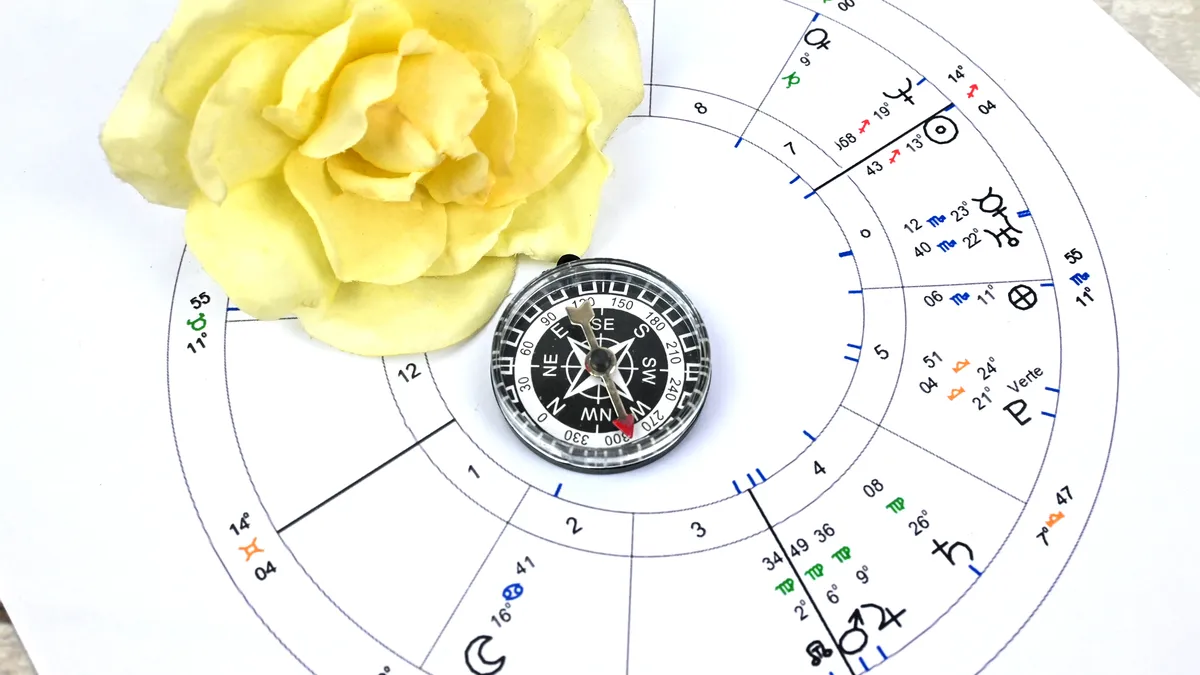
Finding this placement takes your birth date, birth time and birth place, entered into any chart calculator. Most charts show only the north node, drawn as a horseshoe shape. The point you want sits directly across the chart, at the same degree in the opposite sign.

Follow these steps:

1. Generate your natal chart with the most accurate birth time you can find.
2. Locate the north node symbol and note its sign, degree and house.
3. Move to the opposite sign at the same degree. That is your placement.
4. Note the opposite house as well. A north node in the 10th house points to a 4th house placement on the other side.

The opposite signs pair like this: Aries and Libra, Taurus and Scorpio, Gemini and Sagittarius. The other three pairs are Cancer and Capricorn, Leo and Aquarius, and Virgo and Pisces. If you know one point, you always know the other.

Birth time matters for the house, not usually for the sign. The nodes move slowly, so people born many months apart often share the same nodal signs. The house is where your version of the pattern becomes personal.

You can also calculate it by hand with an ephemeris, a table of planetary positions listed by date. Look up the north node on your birthday, then flip it to the opposite sign and degree. The result matches what a chart calculator shows.

## What does each sign placement look like?

Each sign on this axis describes a familiar strength that can harden into a default setting. The table below lists all twelve placements with the pattern, the fear it often guards, and the growth direction on the north node side.

<table>
<caption>South node signs: the familiar pattern, what it often protects, and the north node direction</caption>
<thead>
<tr><th>South node sign</th><th>Familiar pattern</th><th>Fear it often guards</th><th>North node direction</th></tr>
</thead>
<tbody>
<tr><td>Aries</td><td>Acts alone and fast</td><td>Depending on others</td><td>Libra: partnership and receptivity</td></tr>
<tr><td>Taurus</td><td>Holds on to comfort and routine</td><td>Loss and change</td><td>Scorpio: shared depth and renewal</td></tr>
<tr><td>Gemini</td><td>Gathers facts, talks around feelings</td><td>Committing to one belief</td><td>Sagittarius: meaning and faith</td></tr>
<tr><td>Cancer</td><td>Caretakes and stays close to home</td><td>Exposure in the wider world</td><td>Capricorn: public responsibility</td></tr>
<tr><td>Leo</td><td>Performs and needs to be seen</td><td>Being ordinary or unloved</td><td>Aquarius: community and shared vision</td></tr>
<tr><td>Virgo</td><td>Fixes, critiques, over-prepares</td><td>Chaos and blame</td><td>Pisces: trust and surrender</td></tr>
<tr><td>Libra</td><td>Accommodates and keeps the peace</td><td>Conflict and abandonment</td><td>Aries: self-direction</td></tr>
<tr><td>Scorpio</td><td>Lives in intensity and control</td><td>Betrayal</td><td>Taurus: simplicity and steady trust</td></tr>
<tr><td>Sagittarius</td><td>Preaches and keeps moving</td><td>Being pinned down</td><td>Gemini: listening and curiosity</td></tr>
<tr><td>Capricorn</td><td>Achieves and carries the load</td><td>Failure and dependency</td><td>Cancer: tenderness and home</td></tr>
<tr><td>Aquarius</td><td>Detaches and stays above the group</td><td>Emotional engulfment</td><td>Leo: heart and personal expression</td></tr>
<tr><td>Pisces</td><td>Dissolves, rescues, escapes</td><td>Harsh reality</td><td>Virgo: grounded daily care</td></tr>
</tbody>
</table>

Read each row as a tendency, not a verdict. Your Moon, your Saturn and your early life all shape how this placement actually behaves. Two people with a Libra placement can look very different, even though both may share a quiet dread of the first hard conversation.

## What does the house placement add?

A house is one of twelve areas of life in a birth chart, such as money, family, partnership or career. The house version of this point shows where the old pattern plays out most often. The sign describes how you repeat; the house describes where.

A few placements I see often:

- **2nd house, money and worth:** building security alone. The growth point in the 8th asks you to share resources and trust.
- **4th house, home and family:** comfort in private, protective roles. The growth point in the 10th points toward a visible public role.
- **6th house, daily work and health routines:** busy usefulness as identity. The growth point in the 12th asks for rest and an inner life.
- **7th house, partnership:** defining yourself through another person. The growth point in the 1st asks you to know your own wants.
- **8th house, shared resources and intimacy:** merging, crisis and intensity. The growth point in the 2nd asks you to build worth from the inside.
- **10th house, career and public role:** achievement as proof of worth. The growth point in the 4th asks you to come home to yourself.

A 7th house placement often overlaps with patterns around closeness and distance. If that sounds familiar, the article on [fearful avoidant attachment](/patterns/fearful-avoidant-attachment-pattern) explores the push and pull in more depth.

## Is the true node the same as the mean node?

The true node and the mean node are two ways of calculating the same lunar crossing point. The true node tracks the Moon's actual position, which wobbles slightly back and forth. The mean node is a smoothed average of that motion.

People sometimes ask whether the true node is the descending node. It is not. "True" describes the calculation method, and most software applies it to the north node by default.

Your placement is always exactly opposite whichever north node you choose. The gap between true and mean is usually small. It only changes your reading when the point sits right at the edge of a sign, so check both if your placement lands near a boundary.

## Is Ketu the same as the descending node?

Ketu is the Vedic astrology name for this axis point, and Rahu is the name for the north node. In that tradition, Ketu is linked with detachment, spiritual insight and what the soul has already mastered. The tone overlaps closely with Western readings of the same placement.

One technical difference matters. Vedic astrology uses the sidereal zodiac, which is measured against the fixed stars rather than the seasons. Your Ketu may land in a different sign from your Western placement, so compare readings only within the same system.

## Does everyone have a lunar node axis?

Every birth chart contains both lunar nodes, because the Moon's orbit always crosses the ecliptic somewhere. Nobody is born without this point. Some chart wheels simply leave the symbol off, which can make it look missing.

People also ask whether this point counts in a stellium. A stellium is a cluster of three or more planets in one sign or house. Most astrologers count only planets, since the node is a calculated point rather than a body in the sky.

The node still adds weight to a crowded area of the chart. A planet in conjunction with it, meaning it sits very close by degree, often carries the old pattern strongly. A Mercury there may over-explain, and a Venus there may over-accommodate in love.

## Why do patterns resurface at certain ages?

Old patterns tend to return when slow planets press on the chart. Saturn is the clearest example, because Saturn rules structure, limits and the tests that show what is load-bearing.

When Saturn squares your natal Saturn, which happens around ages 21 to 22 and again around 36 to 37, the old strategy often gets tested under pressure. The habit that carried you stops carrying you quite as well. Many people describe that moment as hitting the same wall in a new building.

The Saturn return comes around ages 27 to 30, and again around 57 to 60. Those years often bring a reckoning with what you built on autopilot. Saturn opposes its natal position around ages 14 to 15 and 44 to 45, which can feel like the world pushing back against an old role.

Jupiter returns roughly every 11.9 years, and its returns often open doors toward the growth side instead. Around age 50, the Chiron return can touch old wounds tied to the same axis. None of these timings guarantee an event; they mark seasons when the pattern is easier to see. If any of this touches a deeper wound, [shadow work](/patterns/what-is-shadow-work) offers a way to meet it directly, and so does tracing [your sense of purpose](/patterns/what-is-purpose) back to its root.

## When do planets stir this pattern in 2026 and 2027?

A transit is a planet's current position touching a sign or point in your birth chart. When a planet moves into the sign that holds your placement, the familiar pattern may feel louder. That can be useful, because a louder pattern is easier to notice.

The dates below come from current ephemeris tables, which you can check against [the Astrodienst ephemeris](https://www.astro.com/). The ingresses below are planets entering signs. Match each sign to your own placement.

<table>
<caption>Selected planetary ingresses, November 2026 to February 2027, and how they may touch this axis</caption>
<thead>
<tr><th>Date</th><th>Ingress</th><th>If your placement is in this sign</th></tr>
</thead>
<tbody>
<tr><td>November 25, 2026</td><td>Mars enters Virgo</td><td>Urge to over-fix and over-work may spike</td></tr>
<tr><td>December 4, 2026</td><td>Venus enters Scorpio</td><td>Old intensity or control in love may resurface</td></tr>
<tr><td>February 21, 2027</td><td>Mars enters Leo</td><td>Performing for approval may feel louder than usual</td></tr>
</tbody>
</table>

Three ingresses are listed here, each tied to a specific sign. None of them force a reaction. They simply make the old pattern easier to notice, which is often the first real step toward choosing differently.

If you want a fuller map of where you are headed rather than where you have been, read about [the north node meaning in your birth chart](/patterns/north-node-meaning-birth-chart). You can also read more about [how I work with shadow and repeating patterns](/about/iris-vane), or return to [the home page](/) to find other readings.