| Age | Event | Houses or themes often involved |
|---|---|---|
| 7, 14, 21 | Saturn square natal Saturn | Early identity and responsibility pressure |
| 27 to 30 | Saturn return (first) | Career, structure, long-term commitments |
| 36, 43, 50 | Saturn square natal Saturn | Reassessment of work, partnership, worth |
| 42 | Uranus opposition | Disruption, desire for freedom, midlife shift |
| 50 | Chiron return | Old wounds resurface for integration |
| 57 to 60 | Saturn return (second) | Legacy, letting go, redefining later life |
 ## Why Does Chart Interpretation Focus So Much on Repeating Patterns?
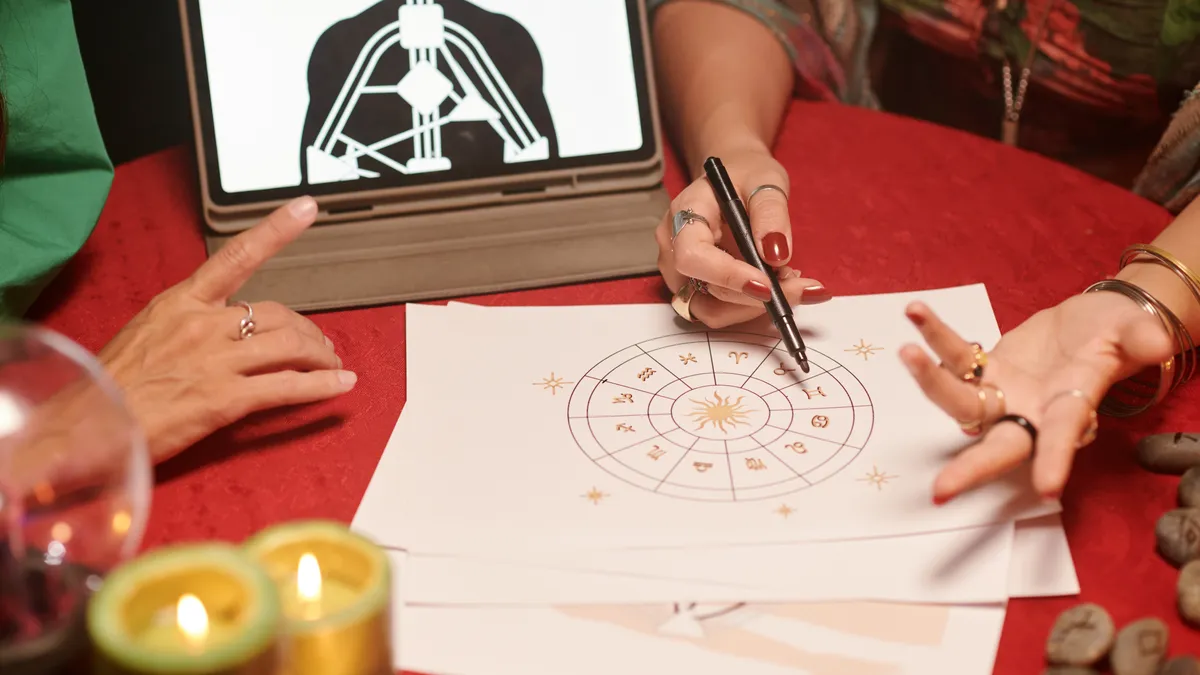
Chart interpretation leans on repetition because a single placement rarely explains a life. It is the combination, the planet, the house, the aspect, and the timing, that reveals why certain situations keep recurring.
If Venus sits in the 8th house of shared resources and squares Pluto, an interpreter might flag a pattern of intense, often controlling, romantic bonds. That is not a character flaw. It is often a protective structure, built because closeness once felt unsafe or unpredictable. A thoughtful reading does not moralize. It asks what the pattern was guarding.
This is the lens that separates shadow-aware interpretation from simple trait lists. A sun in Scorpio does not mean someone is intense in the abstract. It might mean their sense of self quietly organizes around control, because exposure once felt costly. The [mother wound guide](/patterns/mother-wound-astrology-chart) explores one common version of this, where early 4th house and moon patterns echo into adult relationships.
Repetition in a chart usually points to an unmet need, not a flaw. Worthwhile interpretation asks what that need was protecting, long before it suggests how to meet it differently.
## Is a Free Chart Worth It, or Should You Pay for Interpretation?
Free chart generators can calculate your exact placements accurately, since the astronomy itself, verifiable through sources like NASA's [JPL ephemeris data](https://ssd.jpl.nasa.gov/), is public and precise. What they usually cannot do is interpret your specific pattern with nuance.
Most free generators output a list: sun in Capricorn, moon in Pisces, Mars in the 10th house. That is useful raw material. It is also generic, the same paragraph gets served to everyone with that placement, regardless of their actual life context.
A free natal chart reading is a reasonable starting point if you are curious about your placements and want the data without cost. The [free natal chart guide](/patterns/natal-chart-free-guide) walks through how to get accurate placements using your birth time and location.
Deeper interpretation matters more when you want synthesis, when someone traces how your Saturn placement, your 6th house routines, and your Venus aspects all point toward the same repeated story. That synthesis is where pattern recognition lives, and where a reading starts to feel less like a horoscope and more like a mirror.
Neither path is wrong. Free tools answer what your placements are. Deeper interpretation answers why this keeps happening.
## Why Does Chart Interpretation Focus So Much on Repeating Patterns?
Chart interpretation leans on repetition because a single placement rarely explains a life. It is the combination, the planet, the house, the aspect, and the timing, that reveals why certain situations keep recurring.
If Venus sits in the 8th house of shared resources and squares Pluto, an interpreter might flag a pattern of intense, often controlling, romantic bonds. That is not a character flaw. It is often a protective structure, built because closeness once felt unsafe or unpredictable. A thoughtful reading does not moralize. It asks what the pattern was guarding.
This is the lens that separates shadow-aware interpretation from simple trait lists. A sun in Scorpio does not mean someone is intense in the abstract. It might mean their sense of self quietly organizes around control, because exposure once felt costly. The [mother wound guide](/patterns/mother-wound-astrology-chart) explores one common version of this, where early 4th house and moon patterns echo into adult relationships.
Repetition in a chart usually points to an unmet need, not a flaw. Worthwhile interpretation asks what that need was protecting, long before it suggests how to meet it differently.
## Is a Free Chart Worth It, or Should You Pay for Interpretation?
Free chart generators can calculate your exact placements accurately, since the astronomy itself, verifiable through sources like NASA's [JPL ephemeris data](https://ssd.jpl.nasa.gov/), is public and precise. What they usually cannot do is interpret your specific pattern with nuance.
Most free generators output a list: sun in Capricorn, moon in Pisces, Mars in the 10th house. That is useful raw material. It is also generic, the same paragraph gets served to everyone with that placement, regardless of their actual life context.
A free natal chart reading is a reasonable starting point if you are curious about your placements and want the data without cost. The [free natal chart guide](/patterns/natal-chart-free-guide) walks through how to get accurate placements using your birth time and location.
Deeper interpretation matters more when you want synthesis, when someone traces how your Saturn placement, your 6th house routines, and your Venus aspects all point toward the same repeated story. That synthesis is where pattern recognition lives, and where a reading starts to feel less like a horoscope and more like a mirror.
Neither path is wrong. Free tools answer what your placements are. Deeper interpretation answers why this keeps happening.
 ## What Should You Look For in a Good Birth Chart Reading?
A strong birth chart reading names specific placements by sign and house, not vague trait descriptions that could apply to anyone. It also explains the mechanism, meaning it shows why a placement tends to produce a certain pattern, rather than just asserting that it does.
Watch for interpretations that treat the chart as fixed fate. Astrology describes tendencies and pressure points, not guaranteed outcomes. A square between Mars and Saturn suggests friction around assertion and restriction, it does not promise conflict will happen on a schedule.
Good interpretation also connects placements to timing. If a reading mentions your Jupiter return, which cycles roughly every 11.9 years, it should explain what that return tends to activate in your specific chart, not just state the transit exists.
Finally, useful interpretation asks what a pattern protects before asking how to fix it. A 6th house stacked with planets might show up as overwork or health anxiety. The more useful question is what that overfunctioning shields someone from feeling or facing.
## When Should You Revisit Your Chart Interpretation?
Revisiting a chart interpretation makes sense around major transits, since the same natal placements get activated differently depending on what is moving through your sky at a given time. Saturn returns, Jupiter returns, and outer planet transits are common triggers for people to look again.
As of October 8, 2026, Venus is moving through a fast sequence of signs heading into 2027, shifting into Sagittarius on January 8, 2027, then Capricorn on February 4, Aquarius on March 2, and Pisces on March 27. These Venus ingresses move quickly and mostly color short-term mood around love and money rather than reshaping deep patterns.
Slower movers matter more for interpretation. Jupiter enters Virgo on July 27, 2027, a shift that lingers for roughly a year and tends to highlight themes connected to the 6th house, daily work, and health routines, depending on where Virgo falls in your chart. Mars changes signs more often too, moving into Leo on February 22, into Virgo on May 15, Libra on July 16, Scorpio on September 3, and Sagittarius on October 16, each shift changing where friction and drive get expressed for a few weeks at a time.
The deeper markers, Saturn returns and squares, Uranus opposition, Chiron return, are worth revisiting regardless of the current year, since they correspond to ages rather than specific dates. If you are near one of those ages now, that is often a more useful prompt to look again than any single month's planetary weather.
## How Does This Connect to Patterns Beyond the Chart Itself?
Chart work rarely stays contained to astrology alone once someone starts noticing the repeats. The same themes, fear of abandonment, control in intimacy, overwork as armor, tend to show up across a chart, a relationship history, and an attachment style simultaneously.
That overlap is not a coincidence. It is the same underlying pattern expressing itself through different languages. Someone with Venus square Saturn might also test as anxious-avoidant on an [attachment style quiz](/patterns/attachment-style-quiz-explained), and might notice the same caution echoed in their 4th house moon placement.
Chart work also intersects with earlier developmental material. A tense 4th house, the house of home and family, often correlates with patterns explored in [inner child healing work](/patterns/inner-child-healing-astrology), where early moon and Chiron placements shape adult responses to closeness.
None of these frameworks replace the others. They triangulate the same pattern from different angles, which is often more convincing than any single lens alone.
## A Final Word on What a Reading Can and Cannot Tell You
Chart interpretation describes tendencies, pressure points, and likely timing windows. It does not predict specific events, diagnose conditions, or guarantee emotional outcomes, no matter how precise the placements look on paper.
The value is in the pattern recognition, not in certainty. As one astrologer put it, "the chart shows the weather, not the forecast for one specific day." Used that way, chart analysis becomes less about prediction and more about understanding why certain situations keep recurring in your life.
If you want to start with the basics before going deeper into interpretation, the [natal chart explained guide](/patterns/natal-chart-explained) is a plain-language entry point. From there, the [patterns section](/patterns) collects more specific breakdowns by theme, and [the home page](/) has an overview of how all of this fits together across the site.
Reading a chart well means sitting with the discomfort of a pattern before rushing to resolve it. That is the work Iris Vane's approach centers on, more fully described on [the about page](/about/iris-vane). The placements do not change. What changes is how clearly you are willing to look at what they have been protecting.
For a more personal read on your own placements, Iris's readings by email go deeper than any generic report can.
## What Should You Look For in a Good Birth Chart Reading?
A strong birth chart reading names specific placements by sign and house, not vague trait descriptions that could apply to anyone. It also explains the mechanism, meaning it shows why a placement tends to produce a certain pattern, rather than just asserting that it does.
Watch for interpretations that treat the chart as fixed fate. Astrology describes tendencies and pressure points, not guaranteed outcomes. A square between Mars and Saturn suggests friction around assertion and restriction, it does not promise conflict will happen on a schedule.
Good interpretation also connects placements to timing. If a reading mentions your Jupiter return, which cycles roughly every 11.9 years, it should explain what that return tends to activate in your specific chart, not just state the transit exists.
Finally, useful interpretation asks what a pattern protects before asking how to fix it. A 6th house stacked with planets might show up as overwork or health anxiety. The more useful question is what that overfunctioning shields someone from feeling or facing.
## When Should You Revisit Your Chart Interpretation?
Revisiting a chart interpretation makes sense around major transits, since the same natal placements get activated differently depending on what is moving through your sky at a given time. Saturn returns, Jupiter returns, and outer planet transits are common triggers for people to look again.
As of October 8, 2026, Venus is moving through a fast sequence of signs heading into 2027, shifting into Sagittarius on January 8, 2027, then Capricorn on February 4, Aquarius on March 2, and Pisces on March 27. These Venus ingresses move quickly and mostly color short-term mood around love and money rather than reshaping deep patterns.
Slower movers matter more for interpretation. Jupiter enters Virgo on July 27, 2027, a shift that lingers for roughly a year and tends to highlight themes connected to the 6th house, daily work, and health routines, depending on where Virgo falls in your chart. Mars changes signs more often too, moving into Leo on February 22, into Virgo on May 15, Libra on July 16, Scorpio on September 3, and Sagittarius on October 16, each shift changing where friction and drive get expressed for a few weeks at a time.
The deeper markers, Saturn returns and squares, Uranus opposition, Chiron return, are worth revisiting regardless of the current year, since they correspond to ages rather than specific dates. If you are near one of those ages now, that is often a more useful prompt to look again than any single month's planetary weather.
## How Does This Connect to Patterns Beyond the Chart Itself?
Chart work rarely stays contained to astrology alone once someone starts noticing the repeats. The same themes, fear of abandonment, control in intimacy, overwork as armor, tend to show up across a chart, a relationship history, and an attachment style simultaneously.
That overlap is not a coincidence. It is the same underlying pattern expressing itself through different languages. Someone with Venus square Saturn might also test as anxious-avoidant on an [attachment style quiz](/patterns/attachment-style-quiz-explained), and might notice the same caution echoed in their 4th house moon placement.
Chart work also intersects with earlier developmental material. A tense 4th house, the house of home and family, often correlates with patterns explored in [inner child healing work](/patterns/inner-child-healing-astrology), where early moon and Chiron placements shape adult responses to closeness.
None of these frameworks replace the others. They triangulate the same pattern from different angles, which is often more convincing than any single lens alone.
## A Final Word on What a Reading Can and Cannot Tell You
Chart interpretation describes tendencies, pressure points, and likely timing windows. It does not predict specific events, diagnose conditions, or guarantee emotional outcomes, no matter how precise the placements look on paper.
The value is in the pattern recognition, not in certainty. As one astrologer put it, "the chart shows the weather, not the forecast for one specific day." Used that way, chart analysis becomes less about prediction and more about understanding why certain situations keep recurring in your life.
If you want to start with the basics before going deeper into interpretation, the [natal chart explained guide](/patterns/natal-chart-explained) is a plain-language entry point. From there, the [patterns section](/patterns) collects more specific breakdowns by theme, and [the home page](/) has an overview of how all of this fits together across the site.
Reading a chart well means sitting with the discomfort of a pattern before rushing to resolve it. That is the work Iris Vane's approach centers on, more fully described on [the about page](/about/iris-vane). The placements do not change. What changes is how clearly you are willing to look at what they have been protecting.
For a more personal read on your own placements, Iris's readings by email go deeper than any generic report can.